
Author by Zakaria Foodade Director Focus Institute
The following analysis explores the complicated layers of this defense, examining how legal precedents, geopolitical strategies, and cultural movements converge to safeguard the Somali Union against the various “Pandora’s Boxes” that threaten to unleash regional chaos.
The Existential Imperative of the Somali Union
The survival and integrity of the Somali Federal Republic represent more than a mere administrative preference; they constitute an existential necessity rooted in a shared linguistic, religious, and cultural heritage that predates the modern era of statehood. The contemporary Somali state, currently navigating a fragile transition, finds its primary defense in a sophisticated framework of legal fortifications, most notably the 2012 Provisional Constitution, which explicitly declares the sovereignty and unity of the Federal Republic of Somalia as inviolable. This legal architecture is designed to withstand both internal fragmentation and external infringement, serving as a formal expression of the popular will. Despite the proliferation of secessionist narratives in the north and the centrifugal pressures of federal member state autonomies, a broad pro-union majority persists, anchored in the demographic reality of a young population that seeks a unified national identity and a functional government capable of delivering security and economic prosperity to Somalia Wayn. The union is facing challenges that are multi-layered, ranging from the January 2024 Memorandum of Understanding between Ethiopia and the Somaliland region to the unprecedented diplomatic crisis of late 2025 involving Israeli recognition of the breakaway state. Each of these events has tested the resilience of Somali sovereignty, prompting the Federal Government of Somalia to deploy a combination of diplomatic protests, military repositioning, and legislative movements to reassert the indivisibility of the nation.
1. Legal Fortifications and Legal Opinion
The legal precedents of internal and international
1.1 International Law
The international order provides Somalia with formidable defenses rooted in sacrosanct principles. The foremost is the cardinal rule of uti possidetis juris, championed by the African Union (AU), which sanctifies the inherited colonial borders as the borders of independent states. This principle, designed to prevent endless border wars, makes Somalia’s 1960 borders which include so called Somaliland the wuqoyi Galbed inviolable under African and international law. Any unilateral alteration is viewed as a dangerous precedent threatening every state on the continent. This is complemented by Article 2(4) of the UN Charter, which prohibits the threat or use of force against the territorial integrity of any state. While recognition is a political act, facilitating or supporting secession through formal agreements can be framed as a violation of this core tenet, especially when linked to strategic military or economic pacts, as seen in the Ethiopia-Somaliland memorandum of understanding.
The Legal and Diplomatic Armory: Fortifying the Union from the Top Down
The assertion that Somalia’s territorial integrity is defended by the principles of uti possidetis juris and Article 2(4) of the UN Charter is legally sound and forms the bedrock of its position. However, a rigorous legal analysis requires examining the nuances, strengths, and potential counter-arguments within these frameworks.
1. Uti Possidetis Juris: The Unassailable Core Principle
This doctrine, which translates to “as you possess, so you shall possess,” is the most powerful legal instrument in Somalia’s arsenal. Its application is not merely rhetorical but is embedded in the foundational law of the African continent.
· Legal Authority and Precedent: The principle was cemented in African jurisprudence by the International Court of Justice (ICJ) in the Frontier Dispute (Burkina Faso v. Mali) case (1986). The Court held that uti possidetis is a “general principle” of decolonization, stabilizing newly independent states by freezing the administrative boundaries of the colonial period. For Somalia, the relevant “colonial possession” is the State of Somalia that achieved independence on July 1, 1960—the unified entity formed by the union of the former British Somaliland Protectorate and the UN Trust Territory of Somalia (ex-Italian Somaliland). Somaliland’s claim to its pre-union, five-day independence is legally subordinate to this settled post-colonial reality.
· AU’s Constitutional Commitment: The Constitutive Act of the African Union explicitly upholds the principle of “respect of borders existing on achievement of independence” (Article 4(b)). Any recognition of Somaliland constitutes a fundamental breach of this continental constitutional order. The AU’s Peace and Security Council and Assembly have consistently reinforced this, treating secessionist claims as an existential threat to continental stability. Legally, this means any AU member state recognizing Somaliland could be seen as violating its own treaty obligations.
· Somaliland advocates argue that uti possidetis sanctifies their colonial border (the British Somaliland line) and that the 1960 union was a failed merger of two equal states. Legal Opinion: This view is largely rejected in state practice and scholarship. The act of unification and subsequent international recognition of a single Somali state for over three decades created a new, consolidated territorial entity. The international community recognizes the Somali Democratic Republic’s borders, not the prior colonial divisions. Attempts to revert to pre-1960 borders are seen as secession, not the dissolution of a federation, a distinction with profound legal consequences.
2. Article 2(4) of the UN Charter and the “Threat or Use of Force”
Invoking Article 2(4) is strategically astute but operates in a more complex legal domain regarding non-military coercion.
· Classical Interpretation: Traditionally, Article 2(4) prohibits armed aggression. Israel’s recognition or Ethiopia’s MoU, in isolation, are political acts not constituting a classical “use of force.”
· Expansive Contemporary Interpretation: Somalia’s legal argument would seek to expansively interpret “threat or force” in the modern context, as foreshadowed by the ICJ in the Nicaragua v. USA case, which considered coercive acts short of war. A compelling case can be made that recognizing a breakaway region as part of a strategic pact to secure military access (e.g., a naval base) constitutes a form of coercive intervention in Somalia’s domestic affairs. It weaponizes recognition to achieve a strategic military outcome, undermining the sovereign state’s authority. This could be framed as a violation of the principle of non-intervention in the domestic jurisdiction of states (corollary to Article 2(4) and customary international law).
3. Creation and Strategic Legal Pathways for Somalia
A cohesive legal strategy would integrate these principles into actionable diplomatic and judicial avenues:
1. UN Security Council Action: Somalia should continue to frame the issue not merely as a bilateral dispute but as a threat to international peace and security under Chapter VII of the UN Charter. The precedent of external support for secessionism destabilizing an entire region e.g., the Balkans, is a powerful analogy. The goal would be a Chapter VII resolution demanding all states refrain from any act impairing Somalia’s unity, effectively putting international legal force behind the AU’s political condemnations.
2. Request for an ICJ Advisory Opinion: Somalia, with AU support, could seek an advisory opinion from the ICJ on: “In light of the principles of uti possidetis juris and the UN Charter, what are the international legal obligations of states regarding the recognition of, and the conclusion of treaties with, entities claiming to secede from a UN Member State whose sovereignty and territorial integrity is affirmed by the UN Security Council?” A favorable opinion would be a legal sledgehammer.
1.2 Constitutional Bedrock and the Legal Architecture of Sovereignty
The foundational legal document of the modern Somali state is the 2012 Provisional Constitution, which serves as the primary fortification against any attempts to divide the national territory or dilute its sovereignty. Article 1 of this constitution establishes that Somalia is a federal, sovereign, and democratic republic founded on inclusive representation. Crucially, it mandates that all power is vested in the public, but it explicitly prohibits any person or section of the public from claiming the sovereignty of the Federal Republic for personal or localized interest. This clause is a direct legal safeguard against unilateral declarations of independence, providing the Federal Government with the constitutional authority to reject secessionist claims as illegal and unconstitutional.
The constitution further defines the territory of the republic in Article 7, stipulating that the sovereignty of the Somali Republic extends over the land, islands, territorial sea, subsoil, air space, and continental shelf.This definition is not merely geographical but is tied to the historical boundaries recognized at the time of independence in 1960.Any modification to these territories is subjected to rigorous legal requirements, including the necessity of a national referendum for any territorial changes, ensuring that the popular will of the entire citizenry remains the final arbiter of the nation’s borders
The legal framework is reinforced by the concept of “indivisible citizenship” articulated in Article 8, which states that the people of the Federal Republic of Somalia consist of all citizens and are one. This legal standard is critical in countering arguments that specific clans or regions possess a separate “right to self-determination” that would allow for secession. Instead, the Somali legal system views self-determination as a collective right exercised within the context of a unified federal state. This constitutional stance is supported by the 1960 Constitution, which similarly described the Somali people as one and indivisible, establishing a historical continuity of legal intent that spans over six decades.
The supremacy of the constitution, as defined in Article 4, ensures that any law or administrative act that contradicts the principles of national unity is null and void.
2. The 1960 Union: Reclaiming the Narrative and the Rebuttal of Secessionist Claims
The historical narrative surrounding the 1960 union between the British Somaliland Protectorate and the Trust Territory of Somalia is a central arena in the struggle for the union. Proponents of Somaliland’s independence argue that the merger was never legally ratified, citing procedural flaws such as the failure to pass a single, unified Act of Union and a 1961 referendum in which a majority of northern voters rejected the constitution. However, from a pro-union and international legal perspective, these arguments are countered by the principle of state continuity and the long-term de facto and de jure recognition of the Somali Republic.
The “ungratified union” argument rests on the claim that the Legislative Assembly of Somaliland passed the “Union of Somaliland and Somalia Law” on June 27, 1960, while the Southern assembly approved a different “Atto di Unione” in principle but never fully enacted it into law.While these procedural irregularities existed, pro-union legal scholars argue that the subsequent 30 years of integrated governance effectively cured any foundational defects through the principle of acquiescence and prescriptive validity. The participation of northern representatives in the Mogadishu parliament, and the joint representation in international bodies such as the United Nations and the African Union established a single legal personality for the Somali state that cannot be retroactively dissolved based on technicalities from the 1960s
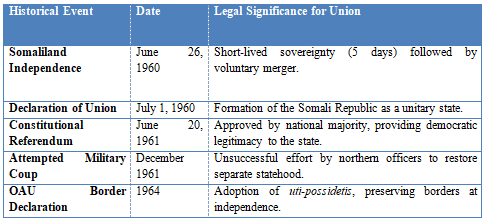
Furthermore, the African Union’s adherence to the principle of uti possidetis the respect for inherited colonial borders serves as a primary international defense of the Somali Union. While Somaliland advocates argue that uti possidetis should protect their 1960 borders, the African Union and the international community have consistently interpreted this principle as applying to the borders of the state as it existed upon the achievement of international recognition and membership in the UN. For the Somali Republic, this means the union of the British and Italian territories is seen as the fulfillment of a pan-Somali aspiration, and any attempt to redraw these borders is viewed as a threat to continental stability.
The 2012 Provisional Constitution effectively supersedes the old Acts of Union, providing a new, inclusive federal model that offers the northern regions a path to autonomy and resource sharing within a unified framework, rather than through total separation.
3. Geopolitical: The Ethiopia MoU and the Israel Recognition Crisis
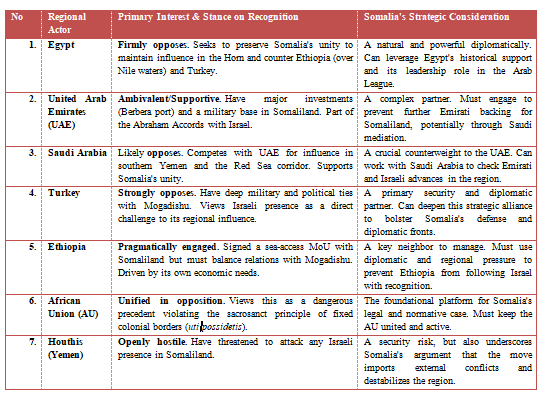
The Somali Union faced its most significant external challenges in decades during the 2024-2026 period. The January 1, 2024, Memorandum of Understanding (MoU) between Ethiopia and the Somaliland administration served as a catalyst for a renewed defense of sovereignty. This deal, which promised Ethiopia a 20-kilometer lease of Red Sea coastline for a naval base in exchange for potential recognition of Somaliland’s statehood, was immediately framed by Somalia unionist as an “expansionist agenda” and a “deliberate attack” on its territorial integrity. The Somali government responded by recalling its ambassador from Addis Ababa and mobilizing a “diplomatic protest and a call to action” that secured condemnations from the United States, Turkey, Egypt, and the African Union.
A more acute crisis emerged on December 26, 2025, when Israel became the first UN member state to formally recognize Somaliland as an independent state. Prime Minister Benjamin Netanyahu the wanted man framed the move as being in the spirit of the Abraham Accords, but Mogadishu denounced it as a “naked invasion” and a “violation of international norms”. President Hassan Sheikh Mohamud alleged that the recognition was contingent on a secret agreement for the resettlement of displaced Palestinians from Gaza and the establishment of an Israeli military base on the Red Sea—claims that transformed Somaliland’s diplomatic victory into a narrative of national betrayal in the eyes of many Somalis.
At its core, Israel’s recognition is a strategic move to gain influence along the vital Bab el-Mandeb Strait, counter Iranian-backed Houthis in Yemen, and create a new security partner in the Red Sea region . This act has placed Somaliland on a volatile regional fault line, intersecting with several pre-existing rivalries.
- · Israel framed the move as being “in the spirit” of the Abraham Accords, with Somaliland pledging to join the framework. The goal is to gain a strategic foothold on the Bab-el-Mandeb Strait, a vital shipping chokepoint, to counter Iranian influence via Houthi rebels in Yemen
- · This move shows how the Accords’ model can be used to pursue unilateral strategic gains with non-state actors, directly challenging the sovereignty of an Arab League/African Union member (Somalia) without regional consensus.
The table below outlines the key actors and their positions:
3.1The Roadmap response
Somalia’s response must be multifaceted, leveraging its unanimous international support while addressing the new geopolitical realities.
1. Diplomatic and Legal Offensive
· Intensify diplomacy to maintain the unified front of the African Union, Arab League, and Organization of Islamic Cooperation . The goal is to transform political condemnation into concrete actions, such as discouraging member states from any engagement with Somaliland that implies recognition.
· Actively work with Egypt and Saudi Arabia to counterbalance the influence of the UAE (and by extension, Israel) in the Horn . Highlight how the recognition fuels regional instability.
· Continue to frame the recognition as a violation of international norms and the AU’s constitutive act. While recognition itself is a political act, Somalia can argue that related agreements (e.g., for military bases) violate its sovereignty and territorial integrity.
· As seen, the UNSC provided a powerful platform for global condemnation. Somalia should continue to seek formal sessions and statements, isolating Israel’s position—which was defended only by the U.S., albeit while reaffirming its own non-recognition of Somaliland
1. Domestic and Public Mobilization
A. Unite Domestic Opinion: The massive public protests across Somalia demonstrate powerful popular support for unity. The government should channel this sentiment to reinforce national cohesion and demonstrate to the world that the union is a popular demand.
B. Counter the Somaliland Narrative: Address the historical grievances cited by Somaliland (e.g., past atrocities under Siad Barre) not by dismissal, but by advocating for inclusive national dialogue and reconciliation. The promise of a fairer union is a stronger counterargument than denial.
2. Strategic and Security Posture
A. Deepen the Turkish Alliance: Turkey is Somalia’s most committed security partner. Strengthening this alliance through continued military training and cooperation is vital for deterrence and bolstering the state’s authority.
B. Publicly Reject Foreign Military Bases: As stated in its official press release, Somalia must consistently declare it “will not permit the establishment of any foreign military bases” on its sovereign territory, framing such moves as acts of aggression that draw the country into proxy wars .
In conclusion, while Israel’s recognition is a serious challenge, it has been met with near-universal diplomatic rejection. Somalia’s path forward lies in skillfully managing regional alliances, relentlessly pursuing legal and diplomatic channels, and strengthening its own governance and national unity. By turning global principles into sustained diplomatic pressure, Somalia can work to isolate this move and safeguard its territorial integrity.
The Federal Dilemma:Navigating Center-Periphery Tensions in Puntland and Jubaland
While external threats often unify the country, internal friction between the Federal Government of Somalia (FGS) and Federal Member States (FMS) like Puntland and Jubaland presents a persistent challenge to national cohesion. These disputes frequently center on the interpretation of federalism, the distribution of powers, and the electoral model for the 2026 national elections. President Hassan Sheikh Mohamud’s administration has advocated for a transition from the traditional clan-based “4.5” system to a direct One-Person, One-Vote (OPOV) model, a move intended to consolidate federal authority and bypass the influence of regional elites.
Puntland, the oldest and most autonomous of the FMS, has been at the center of this friction. In March 2024, Puntland suspended ties with the federal government, citing concerns over unilateral constitutional amendments that expanded presidential powers. Relations deteriorated further as Puntland boycotted National Consultative Council (NCC) meetings, demanding a more decentralized federal model that limits Mogadishu’s control over regional affairs. This political impasse has delayed critical state-building tasks, including the completion of the constitutional review and the unification of the security sector. Jubaland presents an even more militarized challenge to the union. The standoff between Mogadishu and Jubaland leader Ahmed Madobe escalated in late 2024 and 2025 after the federal government rejected Madobe’s regional re-election as illegal. The FGS deployed troops to the Gedo region, seizing control of strategic towns like Beled-Hawo and appointing federal-aligned officials to oversee the area.This Gedo Stratagem reflects the federal government’s attempt to isolate Madobe and create a pro-union pocket within Jubaland, but it has also led to violent clashes and displaced thousands of civilians.
Proposed Frameworks for Reconciliation
To safeguard the union, policy experts and regional mediators have proposed several structured solutions to bridge the divide between the center and the periphery.
- · President HSHM has to come a primary recommendation that is the creation of a neutral council of respected Somali figures to manage FGS–FMS disputes and answer the kismayo’s proposel for National Consultative before 20th Jan, This body would provide a depoliticized platform for dialogue that is The “NCC+” Model Analysts suggest reinvigorating the NCC by including external and civil society observers as a “third-party observatory.”
- · Puntland,Jubaland and opposition leaders have to stand with the unity of Somalia and presents a persistent to national cohesion
Pro-Union Majorities: SSC-Khaatumo and the Rise of Northern Unionism
One of the most significant developments in the safeguarding of the Somali Union is the emergence of the SSC-Khaatumo administration as a powerful pro-union force in the north. For decades, the Sool, Sanaag, and Cayn (SSC) regions were contested between the secessionist Somaliland and the autonomous Puntland. However, in 2023 and 2024, a local uprising in Las Anod culminated in the expulsion of Somaliland forces and the declaration of a direct administrative relationship with the Federal Government of Somalia.
The rise of SSC-Khaatumo represents a moral and legal justification for the pro-union majority in the northern regions who reject secession. Protesters in Las Anod famously carried the blue flag of Somalia, demonstrating that the desire for national unity remains strong even in areas that have been under secessionist control for thirty years. The federal government’s recognition of SSC-Khaatumo in June 2025 provided a significant strategic advantage, creating a pro-union buffer zone that challenges Somaliland’s claim to territorial totality.
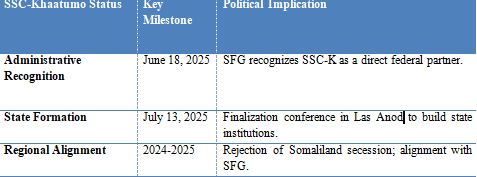
The SSC-Khaatumo process was largely self-financed by the local population and the diaspora, highlighting the power of popular will in shaping the country’s political trajectory. By establishing a functioning administration that adheres to the federal constitution, SSC-Khaatumo provides a model for other northern communities that seek to rejoin the union. This internal restoration of sovereignty serves as a powerful rebuttal to the narrative that the north is a monolithic block favoring independence. Instead, it reveals a complex landscape where the pro-union majority is increasingly assertive in its demand for national belonging.
Recommendations
Based on the analysis of the legal, geopolitical, and internal challenges facing the Somali Federal Republic, the key recommendations that I sagest that is safeguarding the Union of Somalia are:
I. Diplomatic and Legal Recommendations
1. Enforce Continental Norms: Leverage the African Union’s Constitutive Act (Article 4b) to hold member states accountable for violating the principle of respecting inherited colonial borders.
2. Counterbalance Regional Actors: Strengthen strategic alliances with Egypt, Turkey, and Saudi Arabia to act as a diplomatic and security counterweight to the influence of the UAE and Israel in the Red Sea corridor.
3. Pursue an ICJ Advisory Opinion: Somalia should seek a formal advisory opinion from the International Court of Justice to clarify the international legal obligations of states regarding the recognition of secessionist entities in light of uti possidetis juris.
4. Frame Issues under UN Chapter VII: Continue framing secessionist recognition and foreign military pects (like the Ethiopia MoU) not just as bilateral disputes, but as threats to international peace and security to trigger UN Security Council action.
II. Internal Governance and National Unity
Ø Formalize the “NCC+” Model: Reinvigorate the National Consultative Council by including civil society and external observers to create a neutral, depoliticized platform for resolving disputes between the Federal Government and member states like Puntland and Jubaland.
Ø Empower Pro-Union Northern Administrations: Provide full administrative and financial support to SSC-Khaatumo as a direct federal partner. This serves as a model for other northern communities wishing to rejoin the union and challenges the narrative of a monolithic secessionist north.
Ø Address Historical Grievances: Instead of dismissing secessionist claims, the government should lead an inclusive national dialogue and reconciliation process that promises a fairer, more inclusive federal union.
Ø Finalize Constitutional Review: Prioritize completing the constitutional review process to clearly define the distribution of powers and natural resource ownership, reducing the friction that leads to regional autonomy disputes.
III. Security and Sovereignty Action Points
v Reject Foreign Military Bases: Publicly maintain the stance that no foreign military bases will be permitted on sovereign Somali territory, framing such attempts by external powers as acts of aggression an less it a line with our interests and our values.
v Deepen the Turkish Security Partnership: Continue to utilize Turkish military training and cooperation as a primary tool for deterrence and for bolstering the authority of the Somali National Army.
v Mobilize Public Support: Channel the widespread popular sentiment for national unity seen in public protests to demonstrate to the international community that the union is a demand of the Somali people.
